Beijing helped broker the ceasefire. But, according to US intelligence, it started shipping weapons to the country that ceasefire was meant to restrain.
That contradiction sits at the centre of one of the most consequential geopolitical stories of the moment, and it has the potential to unravel not just the fragile US-Iran truce but the already strained relationship between Washington and Beijing.
US intelligence assessments shared with CNN indicate that China is preparing to deliver shoulder-fired anti-air missile systems known as MANPADs to Iran in the coming weeks. These are not symbolic weapons.
MANPADs posed an asymmetric threat to low-flying US military aircraft throughout the five-week war and would directly complicate any resumed American air campaign.
Intelligence officials believe Beijing is working to route the shipments through third countries to mask their origin, a tactic that allows China to maintain deniability while still materially supporting Iran’s military rebuild.
China’s Double Game
The timing is extraordinary. Pakistan served as the official mediator of the 8 April ceasefire, but Trump himself suggested China played a behind-the-scenes role in persuading Iran to negotiate, hinting that Beijing leaned on Tehran to accept a pause.
If accurate, that framing makes the arms shipment reports even more destabilising: China positions itself publicly as a peacemaker while privately helping Iran replenish the weapons systems degraded during 40 days of US-Israeli bombardment.
This is not a new playbook. Chinese military components have been quietly flowing to Iran for years, supporting ballistic missile propellants, guidance systems, and air defence rebuilds. What is new is the scale, the timing, and the degree to which it is now happening openly enough to surface in US intelligence reports while a ceasefire is nominally in effect.
Trump’s public response was blunt. Asked by reporters about the reports, he said China would have “big problems” if it proceeded. Hours after the ceasefire was announced, he had already signed an executive order imposing immediate 50% tariffs on imports from any country supplying military weapons to Iran, with no exemptions. That measure is directed at Beijing as much as at any other party.
Why China Is Doing This
China’s calculus is not difficult to read. A weakened Iran that is forced into a US-dictated settlement, stripped of its nuclear programme, its missile capabilities, and its regional proxy network, would represent a significant expansion of American strategic dominance in a region where China has deep energy interests.
Iran supplies a meaningful share of Chinese oil imports. The Strait of Hormuz, over which this entire crisis has pivoted, is the artery through which that energy flows. A post-war Iran subordinated to Washington’s conditions is a vulnerability for Beijing that China has no interest in accepting.
At the same time, Trump is scheduled to visit China in mid-May for high-level talks with Xi Jinping. The arms shipment intelligence puts Beijing in a diplomatically awkward position: it cannot be seen openly arming a US adversary while simultaneously hosting the American president for what are being billed as stabilising trade negotiations.
The routing of weapons through third countries is therefore not just a tactical choice but a political one, preserving deniability just long enough to get through the summit.
The IMF’s Warning and the Wider Stakes
The geopolitical turbulence is already registering in the global economy. The IMF’s April 2026 World Economic Outlook cut its global growth projection to 3.1% for this year, with the Middle East war cited as the primary new downside risk.
The Fund warned that a longer or broader conflict, combined with worsening geopolitical fragmentation, could significantly weaken growth and destabilise financial markets. Emerging market and developing economies are expected to absorb the sharpest impact, particularly through elevated energy prices and disrupted supply chains.
Brent crude crossed $100 per barrel in March for the first time since 2022, after the Strait of Hormuz closure was announced. The International Energy Agency called it the largest oil supply disruption in the history of the global market.
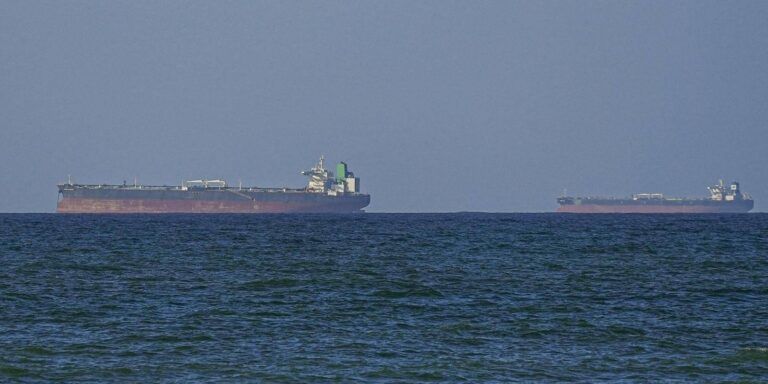
Even with the ceasefire nominally in place, 230 loaded tankers remain trapped in the Persian Gulf, the strait is still contested, and energy markets are pricing in the real possibility that the truce collapses.
A Ceasefire in Name Only
The ceasefire signed on 8 April has been violated by both sides. The US Navy has entered the strait for mine-clearing operations that Iran condemned as a provocation. Israel continues striking Lebanon, explicitly excluded from the truce.
The Islamabad peace talks collapsed on 12 April. And now, intelligence agencies are tracking Chinese arms shipments moving toward a country that is supposed to be standing down.
What is unfolding is not a peace process. It is a pause in which each side is repositioning. Iran is attempting to rearm. China is facilitating that rearmament while maintaining diplomatic cover. The US is blockading a key waterway and issuing tariff threats. And the IMF is downgrading the global growth outlook in real time. The question is not whether the ceasefire will hold. It is what comes after it breaks.
About the Author