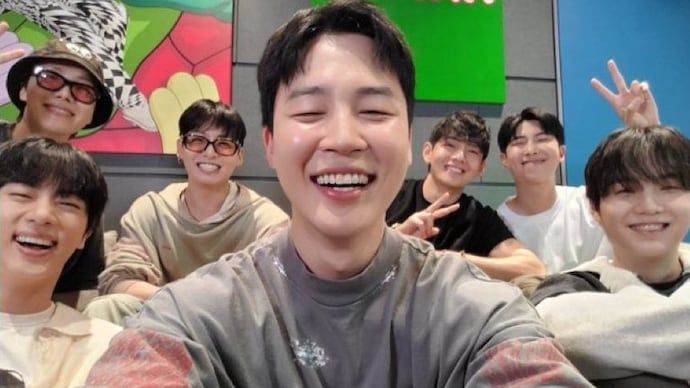
At 8 p.m. in Seoul on Saturday, seven young men walked onto a stage in Gwanghwamun Square, in the shadow of Gyeongbokgung Palace, with the statues of King Sejong and Admiral Yi Sun-shin behind them and somewhere between 200,000 and 260,000 people in front of them.
RM. Jin. Suga. J-Hope. Jimin. V. Jungkook. All seven. Together. For the first time in nearly four years.
The crowd had been building since morning. By noon, eight hours before the show, 24,000 people had already gathered near Gwanghwamun and Deoksugung Palace.
The crowd density was growing 91% every three hours. Police estimated the final count would exceed 260,000, surpassing the 200,000 to 250,000 who packed the streets for South Korea’s 2002 World Cup run and the 175,000 who came to see Pope Francis in 2014.
For context: this is not a stadium. This is a public square in the middle of a city, turned into the largest concert venue in South Korean history.
And beyond Seoul, Netflix livestreamed the entire thing to millions of viewers worldwide. ARMY, the BTS fandom, had been waiting for this for three and a half years. They were not going to miss it.
Why Four Years, and Why Now
South Korean law requires all able-bodied male citizens to complete military service, typically 18 to 21 months. BTS had received controversial exemptions for years, granted to elite athletes and cultural figures who represent Korea internationally.
In 2022, the Korean National Assembly reversed that policy for pop artists. The members enlisted sequentially, starting with Jin in December 2022 and ending with RM and V completing their service last year.
The comeback was announced last July during a live broadcast on Weverse, BTS’s fan platform. More than 7 million viewers watched the announcement simultaneously. That number alone tells you something about the scale of what was waiting on the other side of their service.
The new album, “Arirang,” dropped Friday. Named after the traditional Korean folk song that serves as the country’s unofficial national anthem, it explores themes of personal identity, belonging, and homecoming.
The timing, the name, the venue, all of it points toward something more intentional than a standard comeback rollout. This was a statement about where BTS comes from and what they represent, made at the most symbolically loaded address in the Korean capital.
The Show Itself
The production was extraordinary by any standard. The stage, designed by Guy Carrington and Florian Wieder, was built around the concept of a picture frame, grounding the performance in modern pop energy while honoring the historical weight of Gwanghwamun Square.
A runway-style extension brought the members directly into the crowd. The city of Seoul illuminated its major landmarks simultaneously, turning the Han River bridges, N Seoul Tower, and Lotte World Tower into part of the visual experience.
Guy Carrington described the production as “among the most challenging” he had ever worked on in terms of “sheer logistical complexity.”
He said the team was determined not to build something that felt at odds with Gwanghwamun’s historical and cultural significance.
They succeeded. Every review, every social media post, every camera angle circulating online captures a production that felt enormous and intimate simultaneously, which is the hardest thing to achieve in live performance and the thing BTS has always done better than almost anyone else.
The members wore monochromatic, flowing outfits. The setlist drew from across their catalog, old and new.
The crowd, all 260,000 of them, had their glowsticks out. The color was purple, ARMY’s color, the color associated with trust and devotion in Korean culture. From above, the square looked like a field of violet light.
What This Means Beyond the Concert
South Korean President Lee Jae Myung called the concert “an important opportunity to demonstrate the excellence of K-culture and the high standing of South Korea to the world.” He wasn’t wrong, but the statement is also smaller than the reality.
BTS was the biggest pop act on earth before the military service pause. Their 2019 and 2021 stadium tours set records that hadn’t been approached before.
Their four-year hiatus created what may be the most sustained period of anticipatory fan energy in modern pop history. The album they dropped on Friday debuted at number one in 37 countries simultaneously.
The concert tonight is being watched by fans in Seoul who flew in from Brazil, from France, from the United States, from Japan, from every corner of the world where ARMY exists, which is most of it.
Hye Jin Lee, a professor of communication at USC Annenberg, described the cultural weight of the moment plainly: “This is the comeback of the century. This is the first time we have seen BTS as a group performing. Some of the members have focused on their solo careers, so it’ll be interesting to see how the BTS fandom itself has changed. Everybody’s waiting to see what this comeback will look like.”
The world tour that follows starts in April and runs through March 2027. Thirty-four regions. Their biggest ever. For 12 months, wherever BTS goes, the world will follow.
The Week That Was
It is worth noting the context in which this concert happened. The world this week has been absorbed by war, by missiles landing in Jerusalem’s Old City, by oil above $114, by an F-35 hit over Iran, by a Fed chair under criminal investigation, by Chuck Norris and Nicholas Brendon dying two days apart.
Into all of that walked seven men in purple light, standing in front of a quarter million people in Seoul, doing the thing they do better than anyone alive right now.
There is no political statement in that. There is no commentary on anything beyond the music and the moment. But sometimes that is exactly what the world needs, and sometimes the timing makes something feel bigger than it would have been in a quieter week.
About the Author