
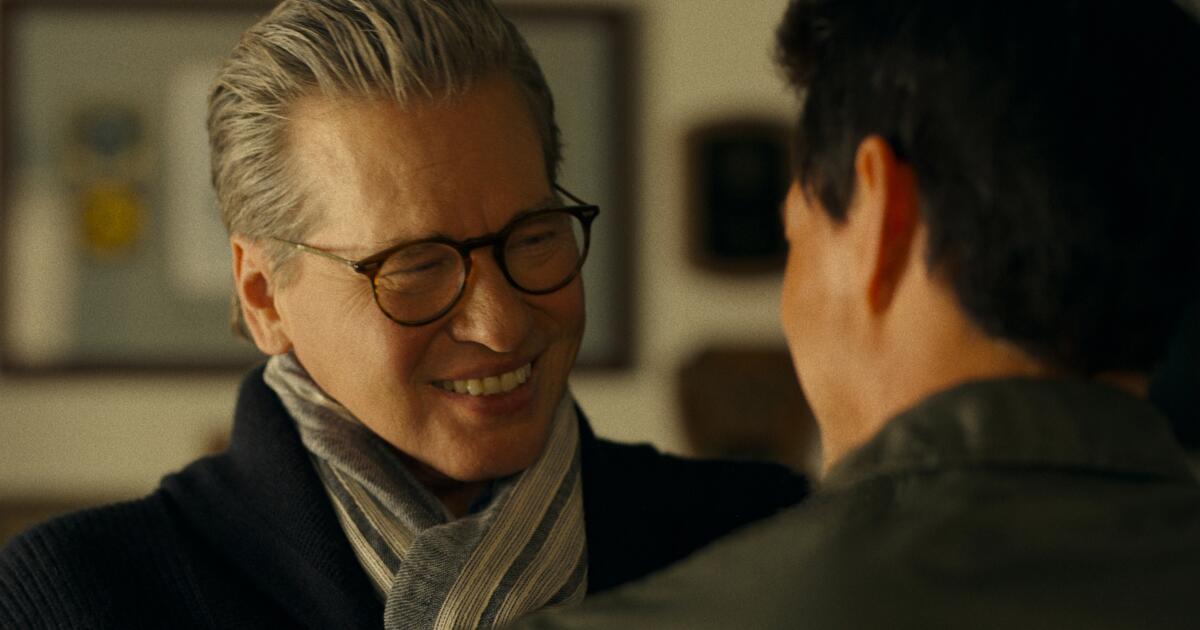
Val Kilmer died in April 2025. He was 65. Throat cancer had taken his voice years earlier, then eventually took the rest.
He had been one of the most compelling actors of his generation, a man who brought genuine intensity to everything from Jim Morrison to Doc Holliday to Batman, and his final years, voiceless and diminished, felt like a cruel end to a career that deserved better.
Less than a year after his death, he is starring in a new film.
Not archival footage. Not a tribute reel. A new, generative AI-enabled performance, built from images and audio of Kilmer across his life, assembled into a character he never actually played on a set he never walked onto.
The film is called “As Deep as the Grave.” It releases later this year. And the conversation it has ignited is one the entertainment industry has been dreading and delaying for years.
How It Happened
Director Coerte Voorhees cast Kilmer five years ago, long before his death. The role, Father Fintan, a Catholic priest and Native American spiritualist, fit Kilmer specifically.
He had Cherokee ancestry. He had a deep connection to the American Southwest. He had signed on. He wanted to do it.
He was also, by the time production was ready for him, too sick to appear. The cancer that had already cost him his natural voice had progressed to the point where showing up on set wasn’t possible. Voorhees faced a choice: recast, or find another way.
He chose another way. Working with the blessing of Kilmer’s estate and the active support of his daughter Mercedes, the production used generative AI to create Kilmer’s performance from existing images and audio, including footage from his later years, after the tracheostomy had changed his voice.
That voice, it turned out, fit the character: Father Fintan also suffers from tuberculosis and speaks with difficulty. Art and life converging in the most uncomfortable way possible.
The production followed SAG-AFTRA guidelines, compensated the Kilmer estate, and has the family’s explicit approval.
Mercedes Kilmer issued a statement describing her father as a man who “always looked at emerging technologies with optimism as a tool to expand the possibilities of storytelling.” She said she was honoring that spirit by supporting the film.
This is, on paper, about as ethically clean as a posthumous AI performance gets. Consent obtained. Estate compensated. Family supportive. Director respectful. And yet the internet is not at peace with it.
Why It Feels Different From What Came Before
This isn’t the first time AI has been used to recreate a dead actor’s presence on screen. It’s not even the first time for Kilmer specifically.
In Top Gun: Maverick in 2022, Sonantic’s AI technology recreated Kilmer’s pre-illness voice so he could reprise Iceman. He was alive when that happened. He cooperated with it. He called it “an incredibly special gift.”
But there is a meaningful difference between an actor choosing to use AI to restore a voice he lost and a director using AI to create an entire performance from a man who has been dead for eleven months.
The announcement has been heralded as “the first movie performance enabled by generative AI,” which is either a milestone or a warning, depending on where you stand.
The online reaction split almost immediately. Some saw it as a loving tribute from a director who wanted to honor an actor he’d believed in.
Others saw it as exactly the kind of normalization the creative community has been warning about. “This is a complete lack of respect for human life and identity,” one widely shared post read. The comments underneath it were evenly divided between agreement and pushback.
SAG-AFTRA has regulations requiring consent for the use of digital replicas. Consent after death, per their guidelines, must come from an authorized representative or the union itself.
The Kilmer estate gave consent. The production says it followed the rules. Critics argue the rules aren’t adequate for what the technology can now do.
The Harder Question Underneath This
If this works, if “As Deep as the Grave” is released and people watch it and respond to the AI Kilmer performance emotionally, what happens next?
The answer is that every studio with access to footage of a dead actor and a story they think fits starts asking the same question Voorhees asked.
The precedent isn’t just about Val Kilmer. It’s about what becomes possible, commercially and creatively, once the first ethical framework gets established and normalized.
Paul Walker was recreated digitally in Furious 7 in 2015. Peter Cushing was digitally recreated in Rogue One in 2016.
James Dean was announced for a new film in 2019, though that project appears to have stalled. Carrie Fisher appeared in The Rise of Skywalker using existing footage.
Each step moved the line a little further. “As Deep as the Grave” moves it further still, because it isn’t using existing footage. It is creating new footage of a dead person saying and doing things they never said or did.
The family supports it. The director respects it. The technology enabled it. And somewhere in there, Val Kilmer, who never actually made it to set, is giving what is being described as a significant performance in a film he will never see released.
The Bear Is Ending Too. A Week of Last Things.
While we’re on the subject of things ending: FX confirmed this week that The Bear will conclude with its upcoming fifth season.
Jamie Lee Curtis, who plays Donna Berzatto, made the announcement somewhat accidentally on Instagram when she posted a wrap photo captioned “FINISHED STRONG” and described the season as “completing the story of this extraordinary family.”
When Access Hollywood asked if she’d confirmed the show was ending, she seemed puzzled that anyone was surprised: “But everybody’s confirmed the show is ending. I don’t understand why that’s such a big deal.”
Deadline and THR both confirmed it. The fifth season, currently filming in Chicago, will be the last.
The Bear is one of the most decorated series in recent Emmy history, with 21 awards across its first three seasons. Its fourth season premiered in 2025 to critical acclaim and will be eligible at the 2026 Emmys in September.
he fifth will presumably be its farewell lap, and given the show’s track record of turning kitchen scenes into profound meditations on grief and family and failure, the finale will almost certainly be worth watching.
About the Author