
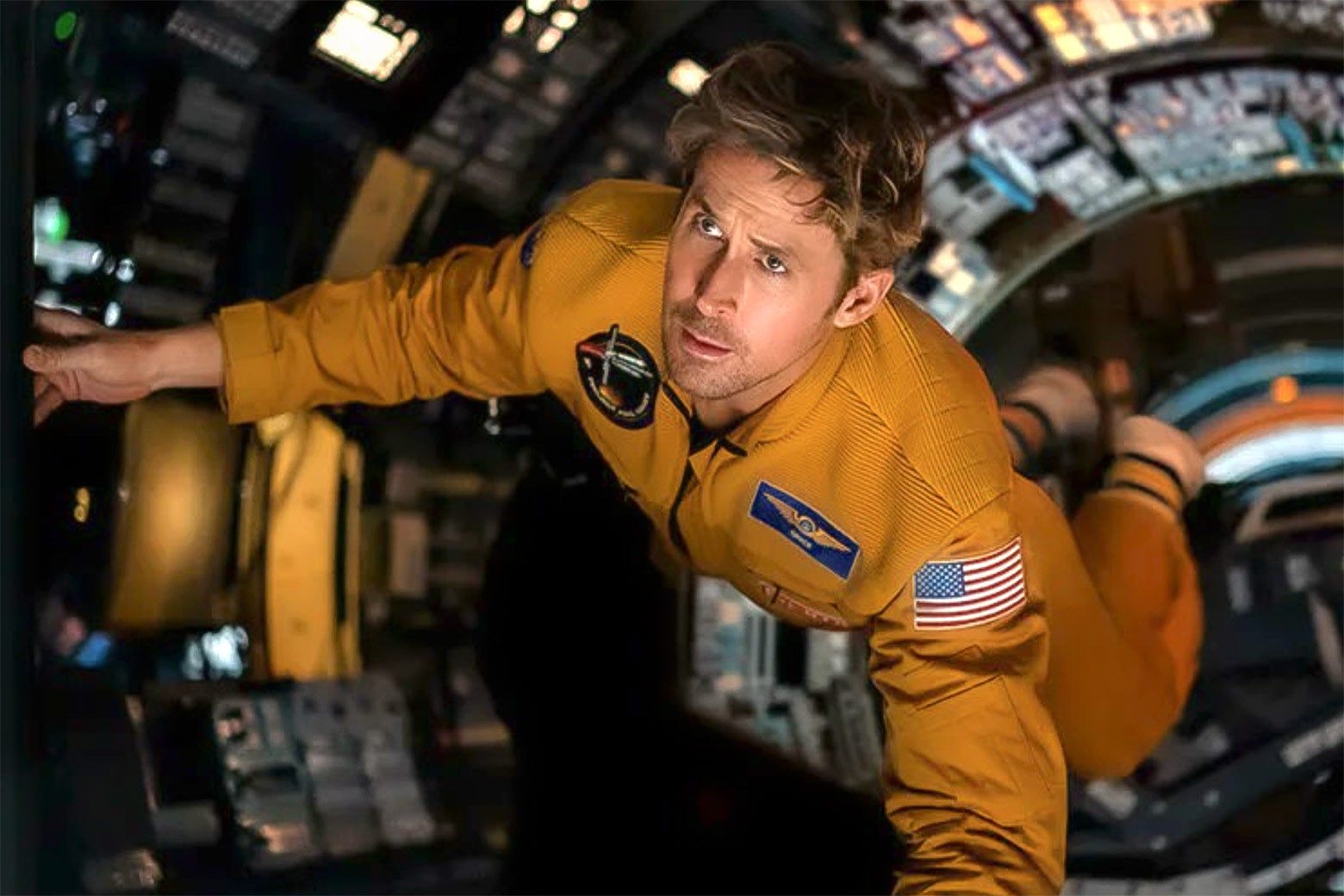
Project Hail Mary opened in theaters today. And if you’ve been paying attention to anything else this week, which is understandable given everything, you may have missed the fact that critics are calling it one of the best science fiction films in decades.
95% on Rotten Tomatoes from over 200 reviews. A 78 on Metacritic. USA Today called it “the first great movie of 2026.” Rolling Stone said it’s the kind of film that makes you feel you’ve “been awakened from a long, deep sleep.” Empire called Gosling and his alien co-star Rocky “the best space-based double-act since R2-D2 and C3-PO.”
That last one isn’t hyperbole. It might actually be underselling it.
What the Film Is Actually About
Ryland Grace, a middle school science teacher played by Gosling, wakes up on a spacecraft light years from Earth with no memory of who he is or how he got there.
As fragments of memory return, he pieces together the situation. The sun is dying, slowly being drained by single-cell organisms called Astrophage. Earth sent him, alone, to the Tau Ceti star system to find the answer before it’s too late. All his crewmates are dead. He has no one to talk to, no one to help him think, and no real plan.
Then he finds Rocky.
Rocky is an alien, roughly the size of a large dog, built like a many-legged Stonehenge and voiced with remarkable expressiveness by puppeteer James Ortiz and the animators at Framestore.
Rocky’s planet has the same problem Grace’s does. Different star, same dying sun, same organisms. They can’t speak each other’s language, they can’t breathe each other’s air, and they have no reason to trust each other. They figure it out anyway.
That’s the whole movie, really. An unlikely friendship between two creatures from opposite ends of the universe, trying to save their homes. Simple premise. Extraordinary execution.
Why Gosling Is Perfect for This
Gosling has always been best opposite someone. La La Land. The Big Short. Barbie. His instinct is to listen, react, give, play off whatever the other person brings.
Most solo blockbuster roles flatten him. This one doesn’t, because Rocky is as fully realized a scene partner as any human co-star he’s worked with.
Rolling Stone noted it directly, writing that Gosling “can actually sell us on an everyman thrust into extraordinary circumstances while still beguiling us with old-school snap, crackle, and pop.” That’s what he does here. Grace is a reluctant hero, a man who doubted himself for years, given one last chance to matter. Gosling plays that without sentimentality and without irony.
Several critics are already calling it a career best performance. It’s early, but they’re not wrong.
Lord and Miller Finally Get Their Blockbuster Moment
Phil Lord and Christopher Miller have been one of the most consistently surprising creative partnerships in Hollywood for fifteen years. The Lego Movie. Spider-Man: Into the Spider-Verse. The Jump Street films. Everything they touch has a warmth to it that most blockbuster directors can’t manufacture.
Project Hail Mary is their biggest canvas, and by most accounts they’ve risen to it. Deadline’s Pete Hammond called it “mission accomplished, an entertaining and engaging piece of science fiction.” Empire gave it four stars. Indiewire said Gosling “goes full Martian, and thank the heavens for that.”
The cinematography is from Greig Fraser, who shot Dune and No Time to Die. The score is from Daniel Pemberton, who did Spider-Verse. The screenplay is from Drew Goddard, who adapted The Martian. This is not a film that cut corners on talent.
The One Honest Caveat
Not everyone is fully on board. Variety’s Owen Gleiberman called it “derivative” and said the film “feels programmed to be The Movie We Need Right Now” in a way that can feel calculated rather than earned. He has a point. The film leans hard on emotional buttons it has clearly identified in advance. The final act stretches past where it should have ended.
Roger Ebert’s site gave it a mixed three stars, saying the film struggles when it “departs from grounded moments to reach for grandiosity.”
Fair criticisms, both. But two dissenting voices against 200 positive ones is not a warning to stay home. It’s a reason to manage your expectations slightly when the third act arrives.
The Timing Is Not Accidental
Here’s the thing about Project Hail Mary arriving in theaters on March 20, 2026. A film about a lone scientist, dismissed by the establishment, who turns out to be right. A film about unlikely cooperation across impossible differences. A film that treats scientific curiosity as heroic rather than suspect.
Rolling Stone put it plainly: “Given the current administration’s blatant disdain for proven intellectual approaches to life, this respect squarely puts the film in the category of escapism.”
People are going to feel that. The film isn’t preachy about it, which is what makes it work. It just believes in something, and lets you sit with that belief for two and a half hours.
Box office projections have it opening between $63 and $65 million domestically this weekend, with analysts saying it needs around $500 million globally to break even given its budget. Based on critic consensus and the sheer size of Gosling’s audience, that seems very much within reach.
Go see it on the biggest screen you can find. Rocky alone is worth the ticket.
About the Author