
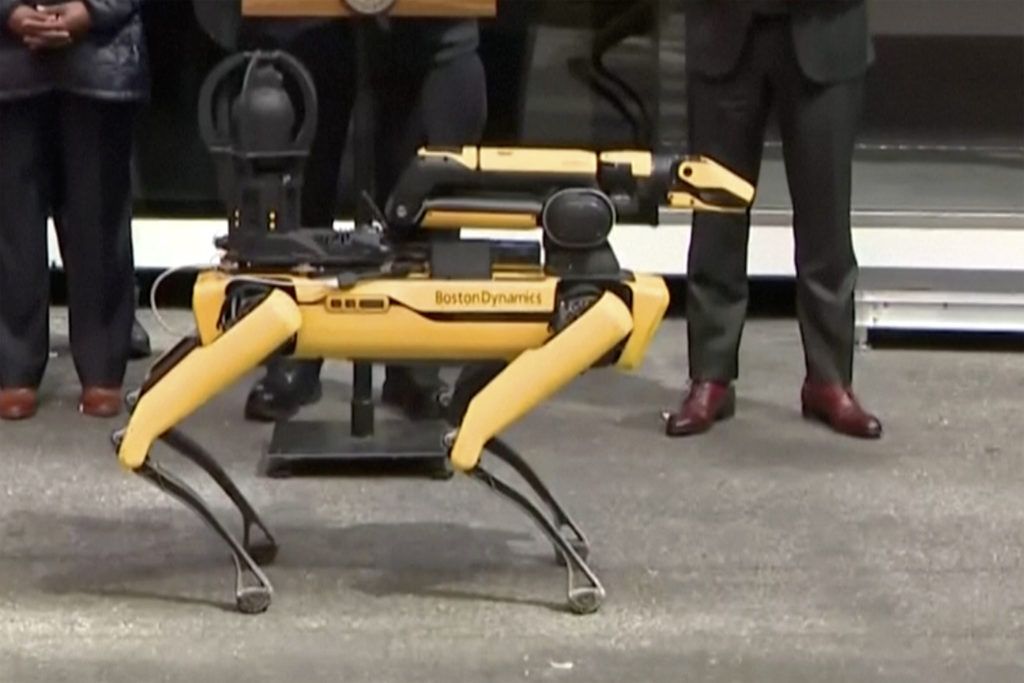
This image taken from video provided by New York City Office of The Mayor, Digidog mobile robot walks during news conference in Times Square on Tuesday, April 11, 2023 in New York. New York City officials unveiled three new high-tech policing devices Tuesday, including Digidog, that critics called creepy when it first joined the police pack 2 1/2 years ago. (New York City Office of The Mayor via AP)
Walk up to certain data centers in the US right now and you might notice something patrolling the perimeter that isn’t human.
Four legs. No face. Moving in that slightly unsettling way that robots move when they’ve been told to look purposeful.
What you’re looking at is Boston Dynamics’ Spot, a quadruped robot that costs anywhere from $175,000 to $300,000 depending on what you bolt onto it, and it’s increasingly the thing standing between the world’s most valuable digital infrastructure and whoever might want to mess with it.
This is not science fiction anymore. It’s Tuesday in America.
Why Data Centers Suddenly Need Robot Guards
The short version: the AI boom created a building frenzy that nobody fully thought through the security implications of. Tech companies are pouring nearly $700 billion into data center infrastructure across the US right now.
There are already 5,000 data centers in the country. Another 800 to 1,000 are being built as you read this. Some of these campuses are the size of 900 football fields.
They house billions of dollars of hardware. They can’t be left unwatched, but hiring enough humans to watch a campus that big, around the clock, in every weather condition, is a different kind of expensive.
That’s where the robots come in. Merry Frayne, senior director of product management at Boston Dynamics, told Business Insider her team has seen a “huge, huge uptick” in interest from data centers over the past year.
Spot can patrol perimeters, monitor construction, map sites, detect thermal anomalies and unusual sounds, flag open doors, and spot leaks, all while a human watches the live feed from a control room somewhere warm and dry.
On a single charge it can cover several miles. It doesn’t call in sick. It doesn’t take a lunch break. It doesn’t file for overtime.
The Math That’s Driving This
Ghost Robotics, the other major player in this space, whose Vision 60 robot was originally built for military reconnaissance, put the business case bluntly.
Michael Subhan, the company’s chief growth officer, told Business Insider: “We know that the cost for a human guard is around $150,000. So we look at that ROI, instead of having two guards at $300,000, you can have one guard and a robot.”
Worth noting: independent wage data from ZipRecruiter puts actual data center security guard salaries somewhere between $35,000 and $48,000 a year, not $150,000.
The robot companies have an interest in making the comparison look favorable. But even at realistic wages, the operational case is real. Boston Dynamics says most customers see a full payoff within two years. Some faster.
Novva Data Centers, a Utah-based colocation operator running a 1.5 million square-foot campus in West Jordan, has already gone public about running a team of Spot robots on-site full time.
They’re doing pre-determined patrol missions, equipment monitoring, and data collection. It’s not a pilot program anymore. It’s the operation.
The Part Nobody’s Talking About
Communities across the US are already pushing back hard against data centers, the noise, the power consumption, the water usage, the way they seem to appear overnight in residential areas without much local input.
Residents in multiple states have organized against new data center projects, citing the strain on local power grids and the fact that these facilities create almost no local jobs relative to their footprint.
And now the jobs they do create, security jobs, the kind that actually employ local people, are being handed to robots instead. Ghost Robotics and Boston Dynamics both say their machines are meant to “augment” human guards, not replace them.
But the math they’re selling to operators is explicitly about replacing two human salaries with one human and one robot. Those two things are not the same pitch.
Where This Goes Next
The broader picture is hard to ignore. Deloitte projects robot shipments will double to 1 million units by 2030, with revenues hitting $21 billion, and $5 trillion by 2050. The AI infrastructure buildout is one of the biggest single markets these companies have ever had access to.
Zak Kidd, founder of AI company AskHumans, put it directly in a recent Fortune interview: “I see AI as an augmentation of knowledge work. But I see robotics, humanoid robotics, as a replacement for manual work.”
That’s a quiet but significant thing to say out loud. The data center boom created a genuine need for physical security at scale.
The robotics industry had a product ready. The economics lined up. And so now, in 2026, the machines guarding the computers that run AI are themselves run by AI.
Nobody planned it that way. It just kind of happened. Which, if you think about it, is how most of this has gone.
About the Author