
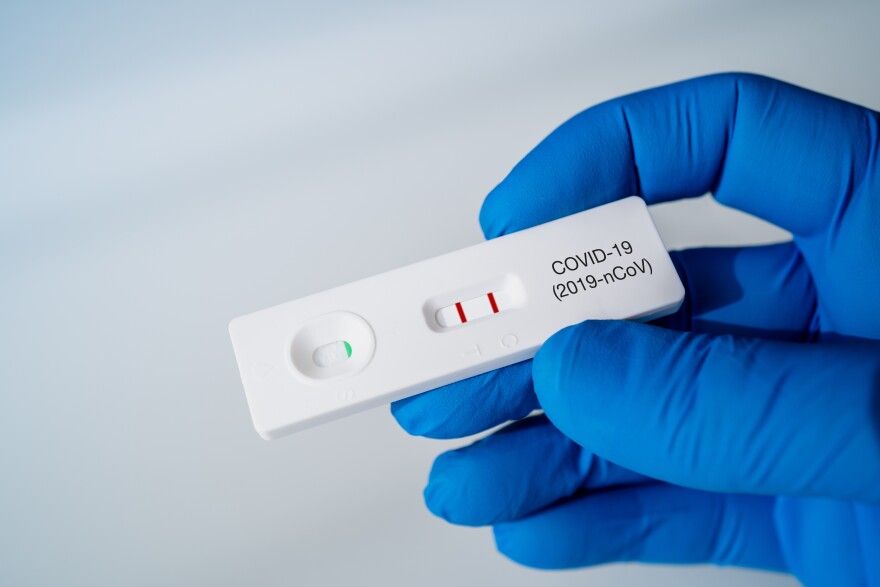
Doctor holding a Positive Result for COVID-19 with test kit for viral disease COVID-19 2019-nCoV. Lab card kit test for coronavirus SARS-CoV-2 virus. Fast test COVID-19.
A new COVID-19 variant is spreading across the United States. The CDC is tracking it. The World Health Organization has it on its monitoring list. And health experts are asking the same question they always ask when a new strain emerges: how worried should we actually be?
The variant is called BA.3.2, but most people know it by its nickname: Cicada.
As of late March, Cicada has been detected in wastewater samples across 29 US states, three major airports, and in clinical cases in multiple countries. It has spread to at least 23 nations worldwide. In Denmark, Germany, and the Netherlands, it now accounts for roughly 30% of all COVID cases.
The honest answer to “how worried should I be” is: moderately alert, not panicking. Here is what the science actually says.
Why the Name “Cicada” Fits
The Cicada variant gets its name from the insect that disappears underground for years before suddenly reappearing in massive numbers.
BA.3.2 descended from the original Omicron BA.3 branch, which circulated briefly in early 2022 and then faded. For nearly three years, it seemed to vanish. Then, in November 2024, it was detected again in South Africa — but carrying 70 to 75 new mutations that had accumulated while it was quietly evolving in the background.
It started showing up more frequently in September 2025. By January 2026, the first US clinical case was confirmed. By March, it was in wastewater from coast to coast.
The name was coined by T. Ryan Gregory, an evolutionary biology professor at the University of Guelph, who has named several COVID variants after natural phenomena. Like the cicada, BA.3.2 spent years underground before resurfacing — and the parallel felt too apt to ignore.
What Makes This Variant Different
The number that matters most about Cicada is 70 to 75.
That is how many mutations it carries in its spike protein compared to the JN.1 lineage that was the dominant branch of COVID for the past two years. The spike protein is the part of the virus that attaches to human cells, and it is what COVID vaccines are designed to target.
When a variant accumulates this many changes to its spike protein, the concern is immune escape. That means the variant may be better at slipping past the antibodies built up through previous infection or vaccination.
The CDC’s official report in the Morbidity and Mortality Weekly Report confirmed that BA.3.2 shows “enhanced in vitro immune escape” — meaning lab tests show it can partially evade current immune responses.
Andrew Pekosz, a virologist at the Johns Hopkins Bloomberg School of Public Health, put it plainly: “The number of mutations from JN.1 viruses makes it less likely that the current vaccines will be highly effective against Cicada, but we need more data to better answer this question.”
The Key Question: Does It Make People Sicker?
This is the most important question, and the answer right now is: no, not more than other variants.
Dr. Adolfo García-Sastre, director of the Global Health and Emerging Pathogens Institute at Mt. Sinai, was direct: “There’s no evidence that BA.3.2 is causing more severe disease or hospitalizations in countries where it’s more widespread. It can still cause problems, of course, but it’s not a more problematic strain than previous ones.”
The CDC’s report confirms this. The first confirmed US clinical cases included two hospitalized adults, but both had pre-existing conditions that independently increase COVID risk. A young child with BA.3.2 was treated as an outpatient and recovered. The CDC explicitly noted that these cases “do not necessarily indicate the variant causes more severe disease.”
Pekosz added: “It looks scary on paper, but it hasn’t really made a big impact in terms of disease in most places yet.”
The good news on treatment: the antiviral drugs that work against COVID, including Paxlovid, still work against BA.3.2.
What Are the Symptoms?
The symptoms of the Cicada variant are the same as other COVID strains. There is nothing new to watch for specifically.
They include fever or chills, cough, shortness of breath, sore throat, congestion or runny nose, fatigue, muscle aches, headache, and nausea. Some people have reported a particularly severe sore throat described as a “razor blade” sensation, though experts say this is not unique to BA.3.2 and is not a sign of more dangerous disease.
Loss of taste or smell is less common with recent variants than in earlier strains but can still occur.
Because BA.3.2 symptoms overlap heavily with those of a common cold, the flu, and seasonal allergies, testing is the only way to know if you have COVID specifically.
Do Your Vaccines Still Work?
This is where the situation becomes more nuanced.
The 2025-2026 COVID vaccines were designed to target the JN.1 lineage. BA.3.2 is genetically very different from JN.1, which means the match between your vaccine and this variant is not as strong as it would be for a more closely related strain.
In lab tests, the vaccines showed weaker effectiveness against BA.3.2 compared to more closely matched variants. A study published in The Lancet confirmed reduced neutralization from vaccine-induced antibodies.
However, vaccines still provide meaningful protection against severe disease and death. They may not prevent mild infection as reliably as they would against a better-matched strain, but they remain the best available tool against ending up in a hospital.
“Nonetheless, vaccines should still help protect against severe illness and death,” Pekosz said.
A vaccine reformulation to target BA.3.2 is being discussed. No timeline has been announced.
Could Cicada Drive a Summer Surge?
This is the question health experts are watching most carefully.
Right now, BA.3.2 accounts for only about 3.7% to 11% of COVID wastewater samples in the US, depending on the tracking method. The dominant strain remains XFG at 53%. Cicada is growing but not yet dominant.
In Europe, however, the picture is more advanced. In Denmark, Germany, and the Netherlands, Cicada already accounts for around 30% of cases. Europe often previews what arrives in the US weeks or months later.
Pekosz said: “It is possible we will see Cicada become the dominant strain in the US, but that is by no means certain. I have heard some concern raised about the possibility that it could drive a US summer surge.”
The warning that follows that statement carries real weight: “Low vaccination rates and little to no public health effort toward stopping COVID infections and spread leaves us vulnerable.”
That is not a statement about this variant specifically. That is a statement about the country’s preparedness for any new variant that appears — and it applies to BA.3.2 as much as anything that comes after it.
What You Should Do Right Now
The CDC’s guidance has not changed dramatically, but the Cicada variant makes following it more important than it might have seemed a month ago.
Make sure your vaccines are current. If you have not had a 2025-2026 COVID booster, get one. It may not fully prevent a Cicada infection, but it significantly reduces the chance of serious illness.
Test if you have symptoms. Because Cicada looks like a cold or the flu without testing, the only way to know is to test. This matters for people who are older or immunocompromised — they need to know quickly so they can access antivirals like Paxlovid.
If you test positive, stay home. Ventilate your space. Wear a mask around others. Contact your doctor if symptoms worsen. Rest and use over-the-counter medications for mild symptoms.
High-risk individuals should be especially careful. Older adults, people with chronic illness, and immunocompromised individuals remain the group most at risk of serious disease from any COVID strain. “The biggest focus is really on protecting higher-risk individuals and continuing standard precautions,” said Neil Maniar, director of the Public Health program at Northeastern University.
The Cicada variant is not the emergency that early COVID waves were. It is not causing mass hospitalizations. It is not, as of now, overwhelming health systems anywhere.
But it is real, it is spreading, and it carries enough mutations to make the public health community take it seriously. Staying informed and keeping vaccinations current is the most useful thing most people can do.
About the Author