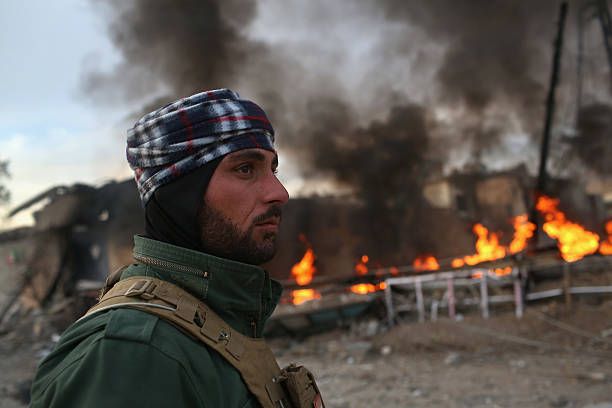
SINJAR, IRAQ - NOVEMBER 15: A Kurdish Peshmerga soldier passes by tires set afire days before by ISIL extremists to hinder airstrikes on November 15, 2015 in Sinjar, Iraq. Kurdish forces, with the aid of months of U.S.-led coalition airstrikes, liberated the town from ISIL extremists, known in Arabic as Daesh, in recent days. Although many minority Yazidis celebrated the victory, their home city of Sinjar lay in complete ruins. Local Yazidi fighters who fought with Kurdish forces and some former residents have been taking any salvagable items out of the rubble, the town being uninhabitable and perilously close to the frontline. (Photo by John Moore/Getty Images)
The airstrikes are the part of this war everyone is watching. The part most people aren’t watching is what is happening on the ground inside Iran, in the mountainous northwest, where the CIA is quietly trying to light a second front.
CNN confirmed this week, citing Kurdish and US officials, that the CIA is in active negotiations with multiple Iranian Kurdish opposition groups to arm them and support an uprising inside Iran.
Trump himself called the leaders of two major Kurdish factions in Iraq on March 1, the day after the war began.
Masoud Barzani of the Kurdistan Democratic Party. Bafel Talabani of the Patriotic Union of Kurdistan. Both calls were confirmed. Talabani said Trump “offered an opportunity to better understand US objectives and discuss joint support for building a strong partnership.”
That is the diplomatic way of saying: Trump asked them if their people would fight.
Who the Kurds Are and Why They Matter
Iran is not a Persian country. That is one of the most consistently misunderstood facts about it.
Persians make up roughly 50 to 60% of the population. The remaining 40% are Azeris, Kurds, Baluchis, Arabs, Lurs, and others, ethnic minorities who have been subject to varying degrees of cultural suppression, economic marginalization, and outright violence from the Islamic Republic for decades.
Kurds are concentrated in the northwest, in provinces like Kurdistan, Kermanshah, and Ilam. They are predominantly Sunni Muslim in a state that enforces Shia governance.
They have been demanding autonomy since before the Islamic Republic existed. The IRGC has been fighting them, on and off, since 1979.
In the Kurdish mountains of Iraq, just across the border, multiple Iranian Kurdish opposition parties have maintained bases, fighters, and weapons for years. Some have trained with US forces. Some have ties to Israeli intelligence. All of them have been waiting for an opening.
On February 22, six days before the US-Israeli strikes on Iran began, five of those parties merged into a single coalition called the Coalition of Political Forces of Iranian Kurdistan. Their stated goals: topple the regime. Achieve Kurdish self-determination.
The timing was not a coincidence.
What Has Already Happened
This is not a plan. It is already underway.
By March 7, US and Israeli airstrikes had destroyed 40 sites in Iranian Kurdistan specifically, targeting IRGC barracks, intelligence bases, military installations, and border guard commands in Sanandaj, Kermanshah, Ilam, Mahabad, and a dozen other towns.
The strikes were so extensive that IRGC and border guard forces evacuated to civilian locations including hospitals to avoid being hit.
ITV News reported that since last year, weapons had been smuggled into western Iran to arm thousands of Kurdish volunteers.
Kurdish sources told the outlet that US and Israeli forces were asked to provide air cover when any ground operation began.
The Kurdistan Freedom Party, PAK, claimed it killed six IRGC members on March 10 and injured three more the same day.
The Kurdistan Free Life Party, PJAK, claimed a sniper killed a police officer in Ilam. Multiple groups reported clashes in Kermanshah and Isfahan.
One PJAK commander, Mazlum Haftan, was photographed near the Iraqi border on February 26. He told AFP: “We cannot take the side of either the Americans or the Iranians. Our cause is different. Our goal is democratic change in Iran.”
That is a careful statement. It is also the statement of a man who knows his forces are in the middle of something much larger than they fully control.
The Protests Nobody Is Covering Enough
Underneath the Kurdish military operations is a popular uprising that has been running since January and has cost thousands of lives.
Iran’s Supreme Council of National Security acknowledged that 3,117 people were killed during the January uprising.
The UN Special Rapporteur on Iran said the real figure could be as high as 20,000. The Iran Human Rights Organisation put it at 3,428.
Amnesty International documented security forces shooting protesters in the head and chest. A doctor in Nishapur said at least 30 people were killed in his city alone, including a five-year-old shot while in their mother’s arms.
Iran cut all internet access on January 8 to conceal what was happening. It stayed cut for weeks.
The protests have not fully stopped. They have gone underground. Strikes. Work stoppages. Quiet acts of resistance.
The bazaar workers in Tehran joined. Hospital workers joined. The Komala Party called a general strike in Iranian Kurdistan and six other Kurdish parties backed it.
The people of Iran are not united behind the regime. The question is whether the conditions for its collapse exist. That question does not yet have an answer.
The Baluchis Are Also Moving
The Kurds are not the only minority the US is working with.
In southeastern Iran, in the province of Sistan and Baluchestan, the Baluchi minority, Sunni Muslims straddling the borders of Iran, Pakistan, and Afghanistan, has been waging its own sustained insurgency.
The IRGC has cracked down on Baluchis with particular brutality in recent years, including a September 2022 massacre in Zahedan that killed at least 96 people in a single day.
The People’s Fighters Front, a coalition of Baluchi nationalist organizations, assassinated the police chief of Iranshahr in January. Multiple PFF fighters killed IRGC members in Dashtiari County. The insurgency is active and escalating.
The Council on Foreign Relations noted this week that US contacts have extended beyond Kurds to include Baluchi militia leaders, opposition groups within the regular Iranian army, and moderate figures within the regime itself.
The goal, per multiple intelligence assessments, is to prepare every available faction for what officials are describing as “the decisive day.”
The Question Everyone Is Avoiding
Neil Quilliam of the UK’s Chatham House called the CIA Kurdish operation “an afterthought” that “has not featured in any major planning to support any broader endgame.” He told Al Jazeera it “reveals that the US-Iran war against Iran has been poorly thought out.”
That assessment is harsh. It may also be accurate.
Iraq 2003 is the unavoidable reference point. The US removed Saddam Hussein in three weeks. Then spent 15 years trying to manage the aftermath.
The ethnic and sectarian fractures that Saddam’s regime had suppressed by force erupted the moment the lid came off.
Kurds, Sunnis, Shia, each pursued their own interests. The state collapsed. A hundred thousand people died in the sectarian violence that followed.
Iran’s ethnic map is even more complex. Persians. Azeris. Kurds. Baluchis. Arabs. Lurs. Each with their own history, their own demands, their own armed factions.
Sardar Pashaei of the Kurdish human rights nonprofit Hiwa put the stakes clearly: “Ethnic minorities are crucial to ensuring that one form of tyranny is not replaced by another.”
The US is arming groups whose stated goal is Kurdish self-determination, not necessarily a unified democratic Iran. Those objectives may be compatible.
They may not be. Nobody seems to have fully thought through which scenario they are actually building toward.
Trump was asked directly whether it was too late to work with figures from within a new Iranian government. His answer: “No, not too late. 49 were killed, don’t forget, so it’s pretty deep, right? New ones are popping up. A lot of people want the job. Some of them will be very good.”
That is not a policy. That is an improvisation.
The bombs are falling. The Kurds are moving. The Baluchis are moving. The protests have not stopped. The regime is degraded but intact. And somewhere inside all of this, there is supposed to be a plan for what comes after.
About the Author